

The 2026 Trump “Polling Collapse” is False
Because they think the real polling data is boring

If you’ve glanced at a screen this morning—February 11, 2026—you’ve seen the panic. The legacy media is in full meltdown mode, screaming about a “historic freefall” in Donald Trump’s second-term approval ratings. They’re treating every decimal point twitch in a Silver Bulletin aggregator like a political earthquake.
The Freefall: Do the Math
The corporate press is selling the idea that Trump’s slide from a 47% inauguration high in January 2025 to the low 40s today is an unprecedented disaster. It’s a compelling title, but statistically illiterate. Liberal bias drives the decision to ignore the massive first-year craters left by their preferred executives to frame a 6-point dip as a “crisis.”
Choi Report analysis reveals a striking double standard when comparing current numbers to the “gold standard” honeymoons the media loves to reminisce about:
Barack Obama began 2009 at 68% and cratered 18 points to 50% by his first anniversary.
Joe Biden started at 57% and took a 17-point nose dive to 40% by January 2022.
By comparison, Trump’s 5-to-7-point fluctuation over the last year is actually the most stable first-year trajectory of the 21st century, no matter what party you like. Labeling this a “collapse” while giving a pass to the double-digit drops of Obama and Biden is narrative management and political news rhetoric, pure and simple.
Reading the Fine Print of February 2026
A sober look at this week’s numbers refutes the “collapse” entirely. While the Silver Bulletin reported a net approval of -13.7 yesterday, they buried the lead: that figure is actually an improvement from last week’s -14.6. Some outliers, such as InsiderAdvantage, even show Trump with a positive net approval rating of +1.
The reality is that we’ve hit a “partisan ceiling.” Trump’s first-term average was 41%, and his second-term average is currently exactly 41%. The numbers haven’t moved because the country hasn’t moved. We are looking at a 92-point gap between Republican and Democratic approval—the same hyper-polarized landscape that the liberal media is desperate to dress up as a new drama.
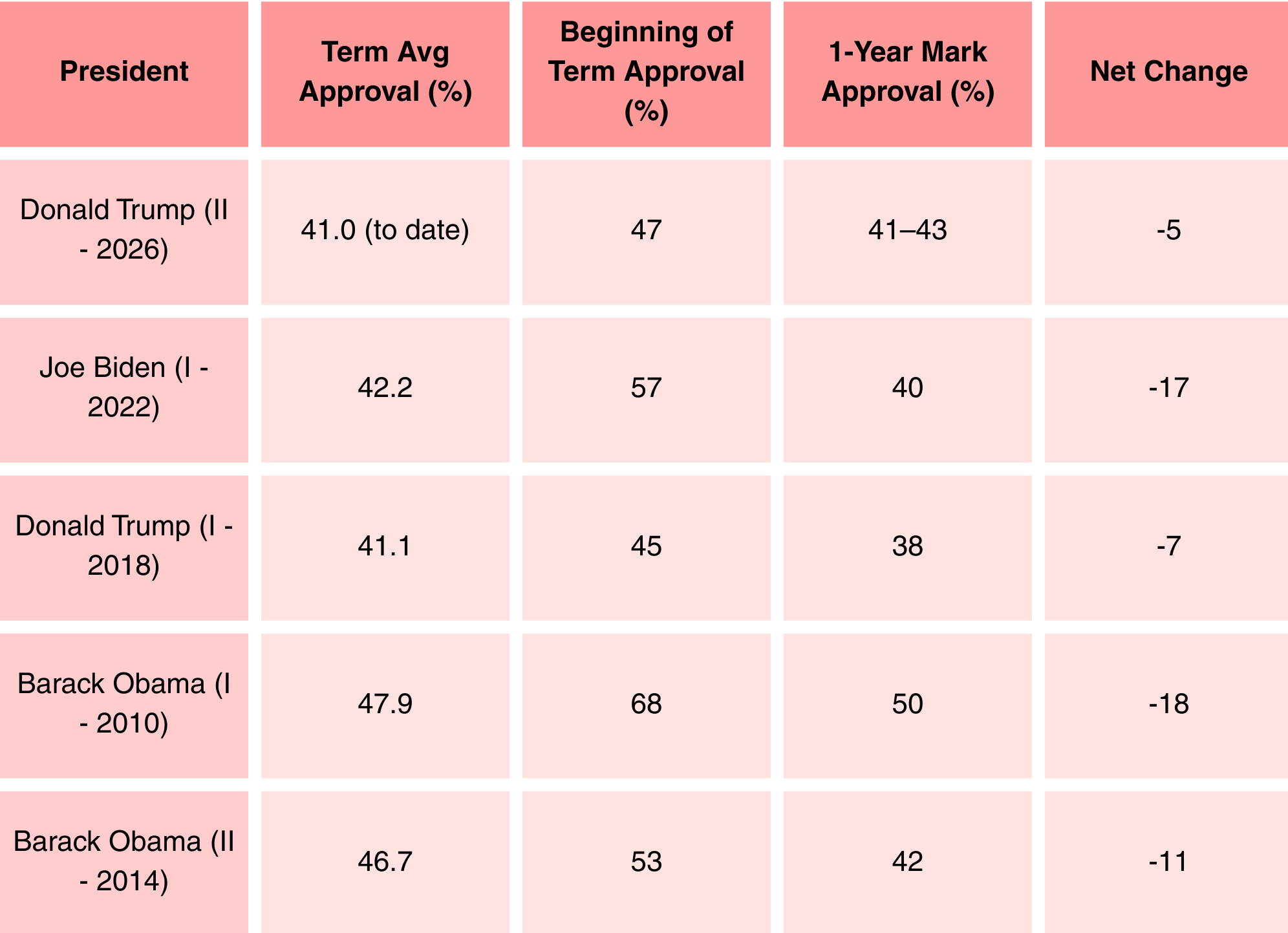
(Historical figures for the Obama, Trump (Term I), and Biden administrations are sourced from Gallup Poll and American Presidency Project longitudinal benchmarks, while current 2026 data reflect aggregates from Ballotpedia and Nate Silver’s Silver Bulletin)
Actually…
Public trust in media has hit a terminal low of 28% for a reason: 36% of Americans now have “no trust at all” in corporate news organizations. While all media carries bias, the sensationalizing of the 2026 poll numbers is a keyhole into a specific failure to report the news impartially. Stripping away context and ignoring the identical trajectories of previous presidents means the media manufactures a fake emergency to suit its own commercial and ideological goals. The “historic collapse” on your screen is just another day at the office for an industry that values your eyeballs more than the truth.
Why the gap between the data and the headlines? Follow the money. By the end of 2025, digital ad revenue cleared $700 billion, and every cent of that is tied to “attention volume”. In this ecosystem, a headline stating “Trump is holding steady at his polarized baseline” is a dead-end for profit. It fails to trigger the emotional engagement required for shares.
To keep the revenue flowing, newsrooms have adopted “crisis inflation,” using keywords like “collapse” and “record low” as click-bait hooks for an audience with a 15-second attention span. This horserace journalism trap relies on obsessing over minor survey shifts rather than actual policy implementation. The media maintains a state of perpetual emergency that keeps you tethered to the screen and the ad servers.
Prove their pessimism wrong by sharing this article.