



The Biological Foundation: Anisogamy and the Functional Norm of Sex
A rationalist inquiry into the nature of sex begins with a commitment to material reality and the observable laws of biology. In the human species, as in all anisogamous organisms, sex is not a subjective spectrum or a social construct, but a binary system defined by reproductive roles.1 At its most fundamental level, biological sex is determined by the type of gamete an individual is organized to produce: large, sessile ova in females and small, motile spermatozoa in males.2 This distinction is the primary driver of sexual dimorphism, shaping the somatic, hormonal, and developmental architecture of the body.1
“If gender is entirely detached from the binary of biological sex, gender could come to refer to any distinctions in behavior, biological attributes, or psychological traits, and each person could have a gender defined by the unique combination of characteristics the person possesses. This reductio ad absurdum is offered to present the possibility that defining gender too broadly could lead to a definition that has little meaning.”
—Mayer, L.S. and McHugh, P.R. (2016) 'Sexuality and Gender: Findings from the Biological, Psychological, and Social Sciences', (Page 88) The New Atlantis, (50), pp. 4–143. Available at: https://www.thenewatlantis.com/wp-content/uploads/legacy-pdfs/20160819_TNA50SexualityandGender.pdf
A central tenet of this argument is that an individual is female when their biological systems are developmentally oriented toward the capacity to bear children. This definition accounts for the functional norm of the species.1 While critics often point to instances of infertility or post-menopausal status as evidence that “female” is an unstable category, this logic fails to distinguish between a functional norm and a functional variation.2 A woman who cannot produce eggs or carry a child due to age, injury, or mutation remains biologically female because her body belongs to the reproductive category organized around those functions.1 These are significant deviations from the norm; if all systems were functioning properly toward the species’ reproductive objective, the individual would possess that capability.1
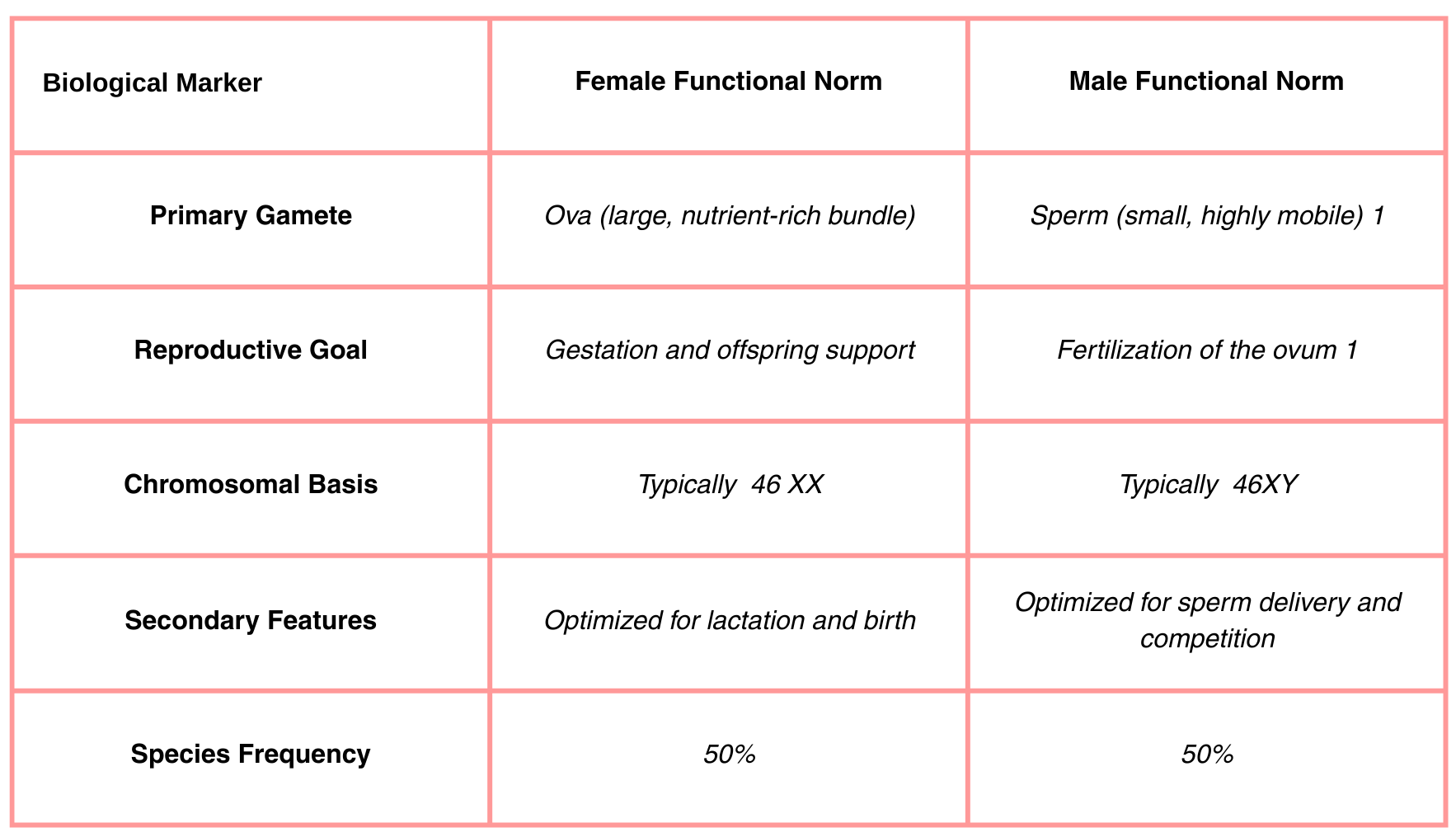
From a rationalist perspective, sex is immutable. While phenotypic expression—such as height or muscle mass—can exist on a continuum, the underlying reproductive categories do not.1 The existence of rare genetic mutations or intersex conditions does not invalidate the binary, much as the existence of people born with fewer than ten fingers does not invalidate the fact that the human species is pentadactyl.1 To contort the biological definitions of an entire society to accommodate a rare minority is an epistemological error that ignores the robust, functional architecture of human life.
The Logical Impasse: Category Errors and Cartesian Dualism in Gender Theory
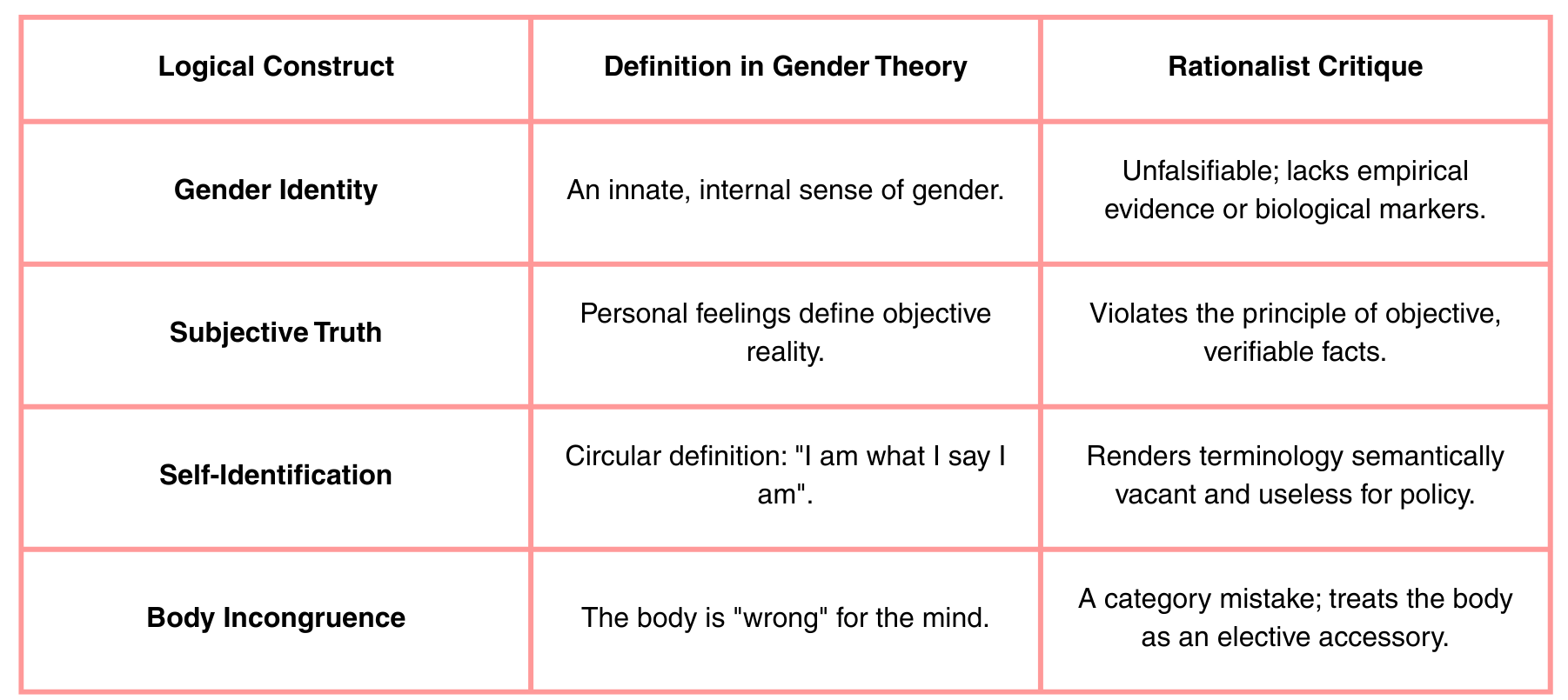
The contemporary movement to redefine sex based on “gender identity” represents a significant departure from rationalist principles. At its core, the concept of gender identity as an “inner sense of being” that can contradict physical biology relies on a form of Cartesian dualism—the belief that the mind or soul is a separate entity trapped in a physical shell.5 Rationalism, however, suggests that the mind is a function of the biological brain, which is itself a sexual organ shaped by the same genetic and hormonal forces as the rest of the body.4
The claim that a biological male can “be” a female because of an internal feeling is a logical category mistake. A category mistake occurs when a person attributes qualities to an entity that belong to a completely different category of things.5 Maleness and femaleness are material, biological properties related to DNA, gametes, and reproductive anatomy; “identity” is a psychological and subjective construct.5 Asserting that a mind has a sex independent of the body is logically unintelligible, as the mind has no reproductive function, no gametes to produce, and no DNA to propagate.5
Furthermore, the definitions used within gender identity theory are often characterized by vicious circularity. If a woman is defined as “anyone who identifies as a woman,” the term has no objective referent.8 This circular reasoning fails the rationalist requirement for clarity and verifiability. Without a grounding in biological reality, the category of “woman” becomes an aesthetic preference or a set of stereotypes rather than a meaningful class of human beings.5 The internal contradictions of the movement—arguing simultaneously that gender is a “social construct” (external) and that gender identity is “innate and immutable” (internal)—further illustrate the lack of a coherent logical framework.7
The Clinical Landscape: Comorbidity and the Reality of Identity Stress
A rationalist approach to suffering distinguishes between the person and the distress they experience. While society should treat individuals experiencing “identity stress” with professional care and compassion, it is a leap in logic to assume the solution is the redefinition of biological traits.6 Data consistently show that individuals identifying as transgender suffer from extremely high rates of co-occurring mental health and neurodevelopmental conditions, suggesting that gender dysphoria may often be a manifestation of deeper issues.6
Research into the comorbidity of so-called gender-diverse populations reveals they are 3.03 to 6.36 times more likely to be autistic than the general population.7 This high correlation suggests that “identity stress” may be linked to sensory processing issues, social alienation, and rigid thinking patterns associated with the autism spectrum.7 Rather than affirming a change in sex, a rationalist clinical model would first address these underlying neurodivergent traits and psychiatric struggles.6
The shift from “Gender Identity Disorder” to “Gender Dysphoria” in the DSM-5 was driven by political activism aiming to “de-psychopathologize” the condition rather than new clinical breakthroughs.6 By framing the distress as the only problem and the identity as “healthy,” the medical community has removed protections provided by traditional exploratory therapy. This affirmative care model often ignores evidence that many who feel alienated from their sex are processing trauma or undiagnosed neurodiversity.6 In a survey of 237 detransitioners, 70 percent eventually realized their gender dysphoria was related to other underlying issues, such as trauma or autism, which were overlooked during their initial medicalization.13
Historical Parallels: Medical Trends, Hysteria, and the Lobotomy Era
The current medicalization of identity stress is not the first time the scientific community has been swept up in a cultural trend prioritizing radical intervention over psychological resolution.11 Rationalism demands we look at the historical record of similar attempts to “fix” internal distress through physical alteration.14
The history of “hysteria” in the 19th century serves as a cautionary tale. Physicians attributed women’s psychological suffering to their reproductive organs, particularly the “wandering uterus” (hystera) or the ovaries.15 This led to a wave of invasive surgeries, including oophorectomies, performed in a misguided attempt to “cure” mental distress.15 These doctors were often praised for “progressive” intervention, yet the treatments failed to address the root causes of suffering.15
A more recent parallel is the lobotomy era of the mid-20th century. During the 1940s and 50s, lobotomies were considered a breakthrough in treating severe mental illness, with approximately 3,000 performed in Norway alone between 1940 and 1960.14 The treatment was championed by charismatic leaders and received positive media coverage as a “humane” alternative to asylum life.14 However, the “improvement” noted was often just a state of placidity and loss of personality, and the procedure left thousands permanently damaged.14 The current rise in adolescent girls seeking mastectomies and hormone treatments bears a resemblance to these past medical overreaches.11
The rapid increase in gender-related distress among youth is understood by some as a “social contagion” pattern.11 The Cass Review found that the rise in referrals was driven by a mix of biological and psychosocial factors, including social media and struggles with sexual orientation.8 The review concluded that the evidence base for medicalizing youth is “remarkably weak”.9
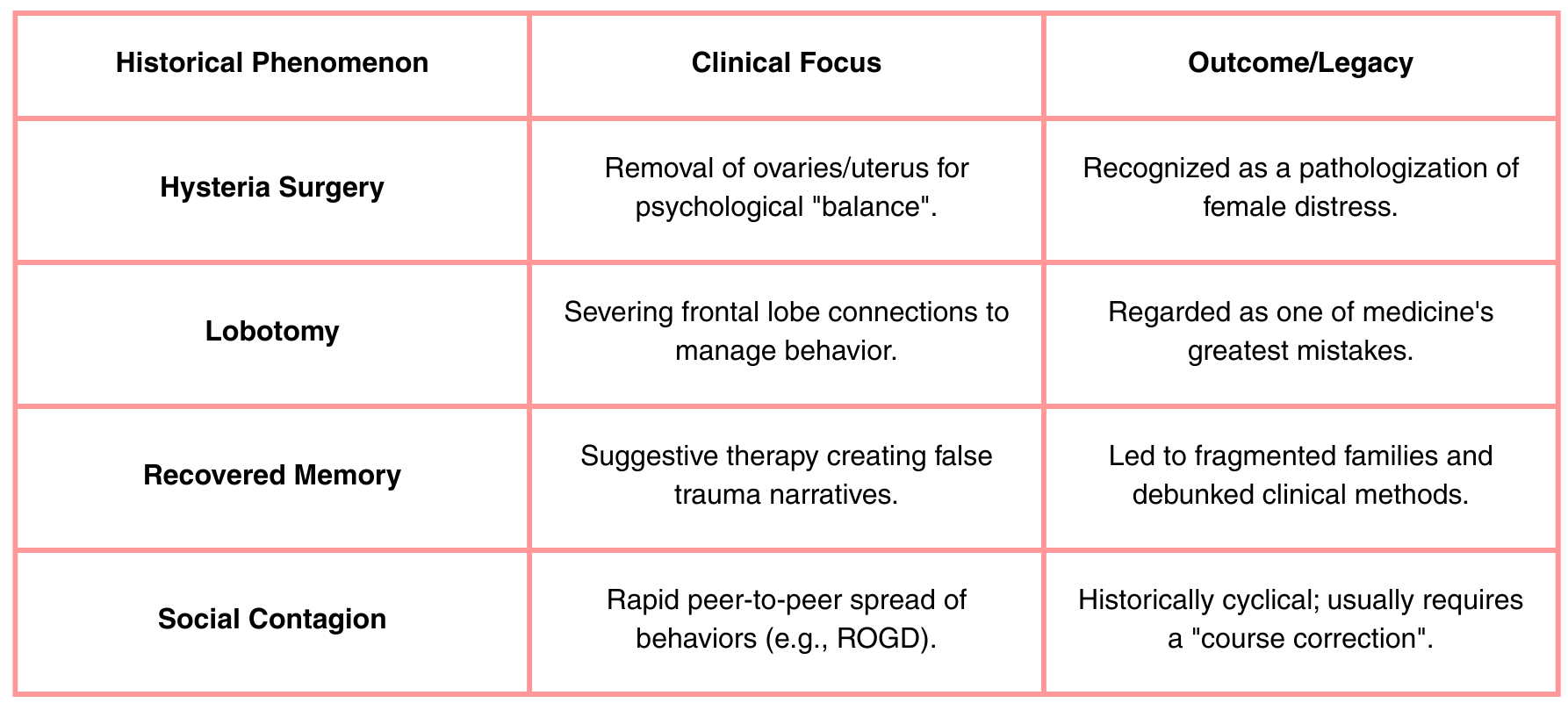
The rapid increase in gender-related distress among youth is increasingly understood by some researchers as a “social contagion” pattern, similar to the spread of multiple personality disorder or bulimia in previous decades.11 The Cass Review, a comprehensive four-year investigation in the UK, found that the rise in referrals was driven by a mix of biological and psychosocial factors, including social media influence, online pornography, and struggles with sexual orientation.13 The review concluded that the evidence base for medicalizing youth is “remarkably weak,” leading to a ban on puberty blockers in public clinics in England.14
The Medical Reality: Surgical Outcomes and the Risk of Regret
A rationalist assessment of gender-affirming surgery must weigh the promised alleviation of dysphoria against the long-term data on mortality and morbidity. While proponents cite high rates of “satisfaction” in the short term, more rigorous, population-based studies suggest a different long-term outcome.25
The Swedish cohort study, which followed individuals for an average of over 11 years (and some for up to 30 years), provides the most sobering data. Even after receiving “state-of-the-art” surgical and hormonal treatment, sex-reassigned individuals had significantly higher risks of death from suicide and psychiatric hospitalization compared to birth-sex controls.25 This suggests that while surgery may temporarily relieve identity stress, it does not address the underlying psychiatric vulnerabilities that often accompany gender dysphoria.25
The physical complications of these procedures are also profound. Cross-sex hormone therapy carries lifelong risks, including increased cardiovascular disease, thromboembolism, and reduced bone mineral density.27 In some studies, transgender women receiving estrogen showed a marked increase in myocardial infarction and stroke.27 Furthermore, the irreversibility of many surgeries—such as mastectomies or gonadectomies—creates a significant risk for individuals who later regret their decision.18
Stories of regret and detransition are becoming more common as the initial cohort of “affirmed” youth reaches adulthood. Detransitioners often report feeling “gaslighted” by medical professionals who presented transition as the only solution to their problems.17 Many describe a sense of “institutional betrayal” when they realized that their distress was actually related to trauma or autism, and that the medical community had permanently altered their bodies rather than treating their minds.17 One detransitioner noted that only those who detransition even inform their former clinicians, meaning the medical community’s data on “regret” is likely a significant underestimate.18
Societal and Economic Costs: The Friction of Contorted Norms
Beyond the individual and clinical level, the redefinition of sex based on identity has significant societal and economic costs. Rationalism looks at the “net cost” to society when fundamental norms are discarded for the preference of a small minority. This cost is seen in the loss of sex-segregated spaces, the erosion of women’s sports, and the financial burden on the healthcare system.31
In the realm of athletics, the inclusion of biological males in women’s categories is not just an aesthetic change; it is a fundamental disruption of fairness. Biological males, on average, possess greater lung capacity, bone density, and muscle mass, which provide an insurmountable advantage in competitive sports.32 When society “contorts” to allow these individuals into female spaces, it results in the “endangerment, humiliation, and silencing” of women and girls.32 This disruption also extends to privacy in locker rooms and bathrooms, where the presence of biological males can cause significant distress and a sense of insecurity for women.32
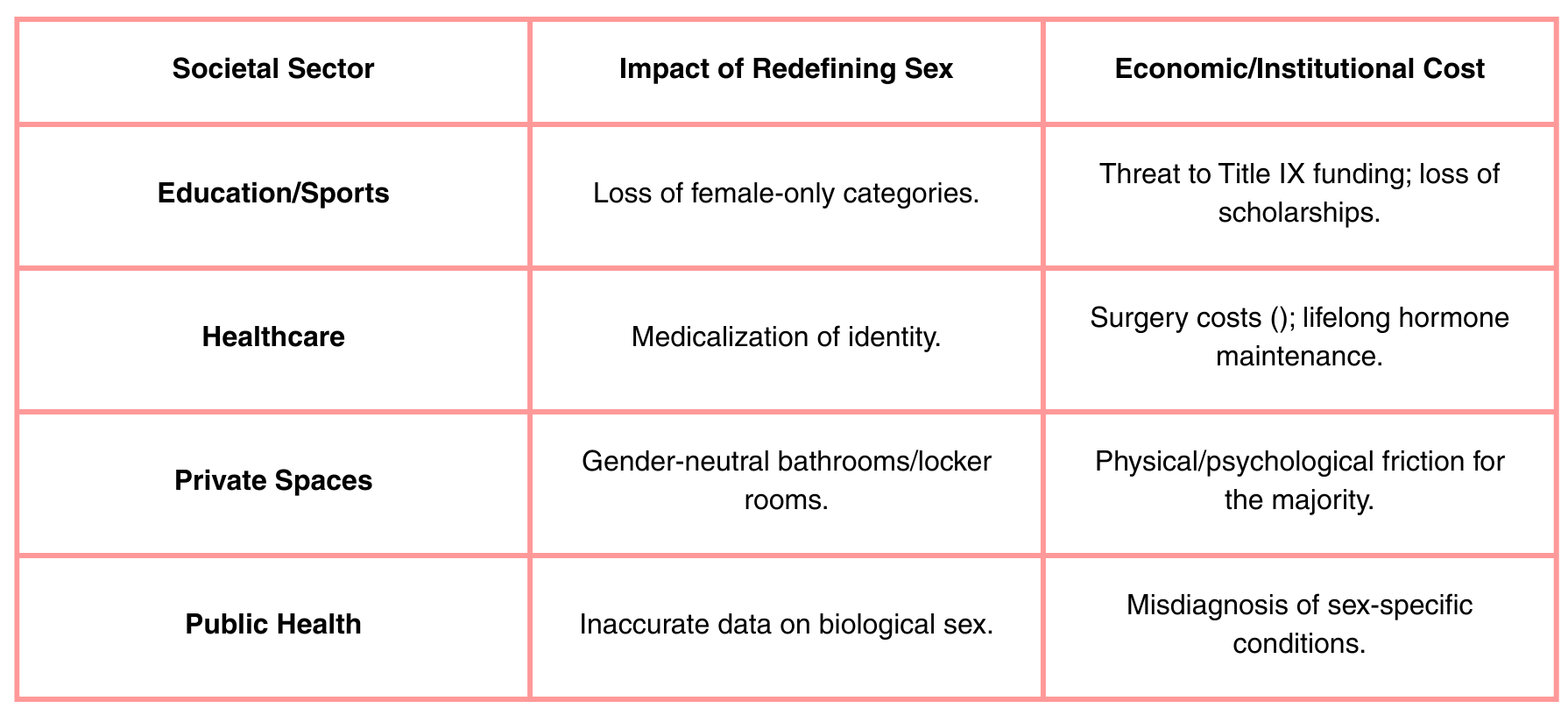
The economic burden of transition-related care is substantial and ongoing. The cost of a single gender-affirming surgery can exceed $100,000 and when combined with lifelong hormone therapy and the high rates of post-transition psychiatric care, the total financial impact on society and insurance payers is massive.31 Proponents argue that transition care is “cost-effective” by preventing suicide, but this claim is contradicted by the long-term data from Sweden showing that suicide risks remain extremely high post-transition.25 Furthermore, the “affirmative” model has been linked to a “diagnostic overshadowing” effect, where other evidence-based treatments for depression or anxiety are ignored in favor of the more expensive and risky pathway of medical transition.40
Toward a Rationalist Resolution: Treating Distress, Not Redefining Biology
The rationalist alternative to the current paradigm is a return to evidence-based, exploratory psychotherapy. Rather than redefining biological traits, society should focus on helping individuals resolve their “identity stress” through psychological means.10 This approach recognizes that identity is a complex, developing construct that is often influenced by external factors and internal conflicts.10
Countries such as Finland and Sweden have already pioneered what they call a “course correction” by making psychosocial interventions the first line of treatment for gender-related distress in minors.14 This holistic approach emphasizes thorough psychological assessment and support, addressing comorbidities like autism and ADHD, and allowing young people the time to mature without irreversible medical intervention.13 By maintaining the biological binary and treating identity stress as a psychological issue, society can offer genuine compassion to the individual without undermining the fundamental truths that govern human existence.6
Works cited
Is Sex Binary? Eight Arguments and a Leading Nonbinary Theory Examined, accessed February 19, 2026, https://www.skeptic.com/article/sex-is-binary/
Mayer, L.S. and McHugh, P.R. (2016) 'Sexuality and Gender: Findings from the Biological, Psychological, and Social Sciences', (Page 88) The New Atlantis, (50), pp. 4–143.
In Humans, Sex is Binary and Immutable by Georgi K. Marinov | NAS, accessed February 19, 2026, https://www.nas.org/academic-questions/33/2/in-humans-sex-is-binary-and-immutable
Is sex still binary? - PMC, accessed February 19, 2026, https://pmc.ncbi.nlm.nih.gov/articles/PMC10842549/
A Discussion about Biological Sex - NeuroLogica Blog - The New England Skeptical Society, accessed February 19, 2026, https://theness.com/neurologicablog/a-discussion-about-biological-sex/
Gender Identity: A Philosophical Challenge, accessed February 19, 2026, https://www.truenorthphilosophy.org/home/pop-culture/transgenderism/gender-identity-a-philosophical-challenge
Egalitarianism as a Revolt Against Nature and Other Essays - Mises Institute, accessed February 19, 2026, https://cdn.mises.org/Egalitarianism%20as%20a%20Revolt%20Against%20Nature%2C%20and%20Other%20Essays_2.pdf
The Philosophical Contradictions of the Transgender Worldview - Public Discourse, accessed February 19, 2026, https://www.thepublicdiscourse.com/2018/02/20971/
Logue | Gender Fictionalism |Ergo an Open Access Journal of Philosophy, accessed February 19, 2026, https://journals.publishing.umich.edu/ergo/article/id/2229/print/
Hernandez | Much Ado About Nothing: Unmotivating “Gender Identity”, accessed February 19, 2026, https://journals.publishing.umich.edu/ergo/article/id/8575/print/
Understanding the Drive to Medically Transition as a Mental ..., accessed February 19, 2026, https://genspect.org/understanding-the-drive-to-medically-transition-as-a-mental-illness/
Restoring Clinical Clarity on Gender Distress - Genspect, accessed February 19, 2026, https://genspect.org/restoring-clinical-clarity-on-gender-distress/
Comorbidity Archives - Stats for Gender, accessed February 19, 2026, https://statsforgender.org/category/comorbidity/
The Final Cass Review and the NHS England Response - SEGM, accessed February 19, 2026, https://segm.org/Final-Cass-Report-2024-NHS-Response-Summary
Psychodynamic psychotherapy for gender dysphoria is not ..., accessed February 19, 2026, https://pmc.ncbi.nlm.nih.gov/articles/PMC11201722/
Transgender individuals at greater risk of mental health problems, accessed February 19, 2026, https://ysph.yale.edu/news-article/transgender-individuals-at-greater-risk-of-mental-health-problems/
Common Co-occurring Conditions and Impacts of Gender-Affirming Care on Chronic Conditions in Transgender and Gender Diverse Populations - NCBI, accessed February 19, 2026, https://www.ncbi.nlm.nih.gov/books/NBK610258/
Doctors Have Failed Them, Say Those Who Regret ... - Maryland, accessed February 19, 2026, https://mgaleg.maryland.gov/cmte_testimony/2023/fin/1vKg9xIlc0uyeAkohZ-heum7nJ2-knmUh.pdf
Detransition Among Transgender and Gender-Diverse People—An ..., accessed February 19, 2026, https://pmc.ncbi.nlm.nih.gov/articles/PMC9516050/
The socio-cultural evolution of our species: The history and possible future of human societies and civilizations - PMC, accessed February 19, 2026, https://pmc.ncbi.nlm.nih.gov/articles/PMC3327546/
Biologism, Cultural Evolutionism, and Cyclical History | by Nick Nielsen | Medium, accessed February 19, 2026, https://jnnielsen.medium.com/biologism-cultural-evolutionism-and-cyclical-history-6fa0aa1f9e1c
Hysteria by Any Other Name: The Unchanging Treatment of Women in Healthcare (1850–1980) - Hollins Digital Commons, accessed February 19, 2026, https://digitalcommons.hollins.edu/cgi/viewcontent.cgi?article=1085&context=researchawards
Lessons to be learnt from the history of lobotomy | Tidsskrift for Den norske legeforening, accessed February 19, 2026, https://tidsskriftet.no/en/2022/12/essay/lessons-be-learnt-history-lobotomy
Can the History of Lobotomy Tell Us Anything About Transgender Care? - Assigned Media, accessed February 19, 2026, https://www.assignedmedia.org/breaking-news/lobotomy-and-gender-affirming-care
Cass Review - Wikipedia, accessed February 19, 2026, https://en.wikipedia.org/wiki/Cass_Review
Long-Term Follow-Up of Transsexual Persons Undergoing Sex ..., accessed February 19, 2026, https://pmc.ncbi.nlm.nih.gov/articles/PMC3043071/
Evaluation of Mental Health and Satisfaction Following Transfeminine Gender-Affirming Surgery in Thailand - PMC, accessed February 19, 2026, https://pmc.ncbi.nlm.nih.gov/articles/PMC9829121/
Gender-Affirming Hormone Therapy, Vascular Health and Cardiovascular Disease in Transgender Adults - PMC, accessed February 19, 2026, https://pmc.ncbi.nlm.nih.gov/articles/PMC6887638/
Hormone therapy in transgender adults is safe with provider supervision; A review of hormone therapy sequelae for transgender individuals - PMC, accessed February 19, 2026, https://pmc.ncbi.nlm.nih.gov/articles/PMC5226129/
Systematic Review of the Long-Term Effects of Transgender Hormone Therapy on Bone Markers and Bone Mineral Density and Their Potential Effects in Implant Therapy - PMC, accessed February 19, 2026, https://pmc.ncbi.nlm.nih.gov/articles/PMC6616494/
Transition Regret and Detransition: Meanings and Uncertainties - PMC - NIH, accessed February 19, 2026, https://pmc.ncbi.nlm.nih.gov/articles/PMC10322945/
“The Staggering Costs of Being Transgender in the US, Where Even Patients with Health Insurance Can Face Six-figure Bills” - Benji Jones | Mount Sinai, accessed February 19, 2026, https://www.mountsinai.org/about/newsroom/2019/the-staggering-costs-of-being-transgender-in-the-us-where-even-patients-with-health-insurance-can-face-sixfigure-bills-benji-jones
Keeping Men Out of Women’s Sports - The White House, accessed February 19, 2026, https://www.whitehouse.gov/presidential-actions/2025/02/keeping-men-out-of-womens-sports/
The Impact of Transgender Sports Participation Bans on Transgender People in the US - Williams Institute - UCLA, accessed February 19, 2026, https://williamsinstitute.law.ucla.edu/publications/impact-trans-sports-ban-eo/
THE UNEVENNESS OF SOCIAL CHANGE IN WOMEN’S SPORTS IN THE UNITED STATES: HISTORICAL AND CONTEMPORARY PERSPECTIVES, accessed February 19, 2026, https://www.gssiweb.org/sports-science-exchange/article/the-unevenness-of-social-change-in-women-s-sports-in-the-united-states-historical-and-contemporary-perspectives
The Social Costs of Gender Nonconformity for Transgender Adults: Implications for Discrimination and Health - PMC, accessed February 19, 2026, https://pmc.ncbi.nlm.nih.gov/articles/PMC5044929/
Is gender dysphoria associated with increased hospital cost per stay among patients hospitalized for depression? Focus on the racial and regional variance in US hospitals - Frontiers, accessed February 19, 2026, https://www.frontiersin.org/journals/public-health/articles/10.3389/fpubh.2024.1359127/full
Societal Implications of Health Insurance Coverage for Medically Necessary Services in the US Transgender Population: A Cost-Effectiveness Analysis - Reginfo.gov, accessed February 19, 2026, https://www.reginfo.gov/public/do/eoDownloadDocument?pubId=&eodoc=true&documentID=3532
Societal Implications of Health Insurance Coverage for Medically Necessary Services in the U.S. Transgender Population: A Cost-Effectiveness Analysis - PMC, accessed February 19, 2026, https://pmc.ncbi.nlm.nih.gov/articles/PMC4803686/
Study: Paying for Transgender Health Care Cost-Effective | Johns Hopkins, accessed February 19, 2026, https://publichealth.jhu.edu/2015/study-paying-for-transgender-health-care-cost-effective
The Cass Review Final Report (UK), 2024 - Christian Medical and Dental Association, accessed February 19, 2026, https://cmda.org/the-cass-review-final-report-uk-2024/
Understanding therapy approaches to gender distress - Incremental Health Tips, accessed February 19, 2026, https://www.incrementalhealthtips.com/post/understanding-therapy-approaches-to-gender-distress